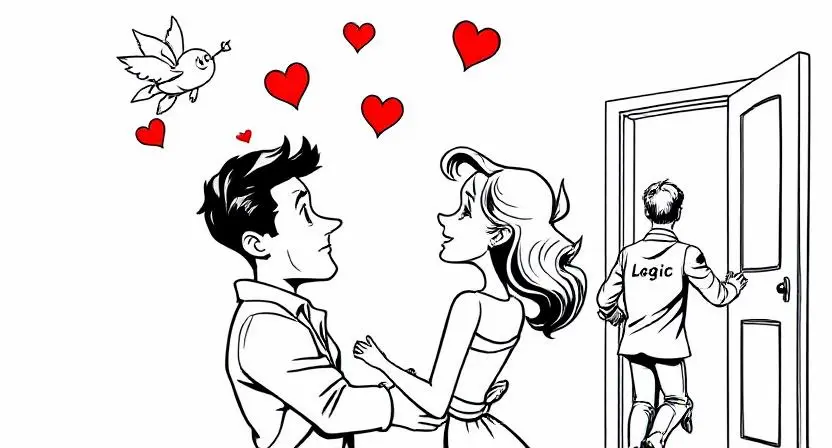
Ready to get your neurons tingling? Let’s talk about what REALLY happens between your ears when you go all in on someone – and why it feels so bloody bonkers.
Let’s be honest: falling in love can make you act like an absolute maniac. You’re lying awake at 2am, replaying a text for the hundredth time, stalking their playlists, and grinning at strangers for no good reason. It’s cringy, dizzying, extra—and absolutely, gloriously normal (even if it doesn’t feel that way).
Why do we do this to ourselves? And why ‘catching feelings’ turns us all a little bit unhinged.
Limerence: Love’s Obsessive Engine
So, you think you’re just smitten? Psychologist Dorothy Tennov coined the term limerence for that all-consuming, slightly chaotic stage of falling in love—aka the reason you can’t get them out of your head. Think: butterflies with jetpacks.
When you’re in limerence, it’s like your brain has been taken over by a five-year-old with a sugar rush. You obsess, you daydream, your mood gets yanked up and down by the tiniest sign of attention (or, God forbid, being left on read). You’ll read way too much into the way they say ‘Hi’.
Sounds a bit obsessive? That’s because it is. Limerence has been compared to the likes of OCD—a mind invaded by someone else, whether you like it or not. But don’t panic, it’s not a disease and you don’t need a cure. Welcome to planet Human.
But why does love feel more like an addiction than a Jane Austen plot? Let’s have a nosey inside your head…
A Blast of Brain Chemistry: Why Love Feels So Mad
Romantic love is basically a full-on neurological rave. Your brain’s reward system lights up like a casino in Vegas, especially the ventral tegmental area (don’t worry, you don’t need to remember the name — it’s kind of your personal fireworks display).
/ For the particularly nerdy:
the ventral tegmental area (VTA) is a cluster of cells deep in your brainstem, discovered to be the birthplace of dopamine – the feel-good messenger responsible for motivation, anticipation, and euphoria. /
This bad boy pumps every text-induced high and ‘OMG, he/she looked at me‘ swoon — launching you onto an emotional rollercoaster that rivals any substance. No wonder scientists say love is the only socially acceptable obsession.
Helen Fisher (big name in love biology) calls falling in love a ‘positive addiction’. Unless it’s unrequited… then roll out the red carpet for withdrawal. Ouch.
But dopamine isn’t partying alone in your bloodstream…
Love’s Hormonal Hit List
There’s a proper hormonal shindig going on:
- Oxytocin (‘the cuddle hormone’) – the reason you want to squeeze and spoon and stare into their eyes like a love-struck puppy.
- Cortisol (hello, stress!) – explains why those first dates leave you sweaty-palmed and slightly nauseous.
- Serotonin – which drops significantly. That’s why your love life does a passable impression of OCD: relentless thoughts, weird rituals, and slightly embarrassing obsessions.
So, your brain’s only real mission at this point? Ensure you’re properly ‘hooked’.
When Reason Takes a Back Seat
Now for the fun part: science says you’re not actually being an idiot — your brain is sabotaging you. The prefrontal cortex (that’s your rational brain) basically takes a holiday. Meanwhile, the pleasure centres scream louder than a hen party in Ibiza.
That’s why you find yourself forgiving the unforgivable: their odd socks, their dodgy jokes, their total inability to use a washing machine. Flaws? What flaws?
No wonder love is compared to ‘Theia Mania’ — ‘madness from the Gods’ by the Greeks. In fact, we’re all just a romantic WhatsApp notification away from sweet insanity.
Is Being in Love Actually a Bit… Unhinged?
Is falling in love actually a sign you’re losing the plot? The answer: not exactly.
You might’ve heard urban legends about the WHO classifying love as a mental disorder, but there’s no such entry in their manuals.
That said, scientists do recognise the overlap with OCD, addiction, and even plain old madness. You become obsessed, prone to questionable decisions, and sometimes embarrassingly needy.
But — no worries — you’re not losing your marbles. It’s only a problem when this behaviour becomes unhealthy — triggering an inner conflict (or… when mutual embarrassment is caught on camera).
Three-Year Myth or How Long Does the Crazy Last?
Relief incoming: the full-throttle, high-voltage phase of limerence does NOT last forever.
You’ve heard the old line: ‘Love only lives three years.’ Researchers estimate the dopamine-fuelled high of limerence usually lasts from six months up to two (sometimes stretching to three) years.
Upon the expiry of delicious idiocy, the chemistry tend to settle down and you (with luck) grow something deeper: proper, grown-up, attachment style love.
Many couples fondly (or not so fondly) remember the chaos—eye rolls optional. The end of limerence isn’t the death of love. It’s a transition—a change of gear from the electrifying ‘madness’ of infatuation to the steadier, more profound terrain of attachment. This is when oxytocin (and those long, contented evenings) take the lead. Love becomes less about fantasy, more about partnership—a move from wild-eyed obsession to grounded devotion.
So, Why Do We Still Fall?
Here’s the real magic: even in a world driven by logic, going coocoo in the name of love brings out our best and worst selves. It’s wild, unpredictable, dazzling, and slightly humiliating—and we can’t help but want more.
Science tells us that love kidnaps our common sense, rewires our reality, and keeps the story moving. But it’s the poetry of it is what makes us crave the madness.
So, next time you’re a cat meme away from a full breakdown over your latest crush, remember: your brain is in on the joke, and you’re in very sexy, very clever, very human company.
Cupid would be proud.
Fancy a scientific take on other steamy topics? Let me know what mysteries you want unravelling next 😉