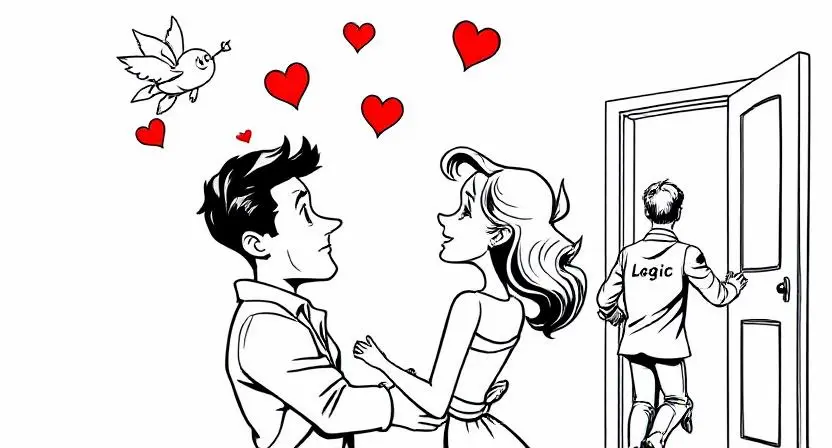
Let’s talk about romantic languages — and no, not French or ‘u up?’ I mean the unspoken, hormone-fueled dance of how we show interest, and accidentally ghost each other while trying to play it cool. And why it gets awkward before it gets wonderful.
While love languages are all the rage, most people forget there’s a whole biological dialect in play long before we reach ‘words of affirmation’ and ‘acts of service’ land.
It’s got testosterone swagger, oxytocin vibes, and just enough dopamine to make you text someone six times before they respond once.
This isn’t a ‘men are from Mars, women need to stop texting first’ kind of thing. It’s science, not stereotype. Biology doesn’t dictate our love language — but it influences the tempo, tone, and triggers.
Man’s Love Language: Doing (And Why That’s Not Just a ‘Hunter Mode’)
Here’s a pattern so old that it’s practically written in our DNA:
A man bonds through doing.
Not receiving. Not over-analysing. Not decoding your 500-word-long text-essay.
Doing.
He bonds when he shows up — builds, fixes, plans, leads, protects. That’s the alchemy of attachment in his nervous system.
Not because he’s a caveman or walking patriarchy, or because you need him to pay for dinner to prove he likes you — it’s because doing activates his investment reflex.
He bonds by effort.
Not by receiving.
Not by being overwhelmed with gifts, praise, or access to your Google calendar.
So when a woman meets a man and immediately goes into ‘Let me give him everything — my time, my secrets, my emotional support, my almond croissant…’
That’s sweet. But also: slightly short-circuiting the chemistry. In human terms? Spooky. While a man might be flattered — ‘Never knew I was THAT cool’ — another thought can slip in: ‘What does she need from me? Wonder if I can afford the payback…’
Because…
Science Break:
Testosterone drives a man’s need to do — to be goal-oriented, active, and take risks. In early attraction, that system softens temporarily: testosterone dips, oxytocin rises, and dopamine spikes, fuelled by novelty and reward anticipation. This cocktail shifts him into emotional bonding mode — with dopamine compensating for the testosterone dip while keeping motivation high.
But if a woman isn’t part of his ‘doing’ — meaning he can’t channel his effort and goal-driven energy toward her or something they’re building together — that drive gets rerouted. To work. To workouts. To whatever gives him that hit and sense of accomplishment.
The result? When his hormones rebalance, the initial excitement fades — because his brain never linked the ‘doing’-related dopamine hit with her. Suddenly, the bond feels less electric, less sticky.
She becomes a feel-good memory, not a bonded motivation.
That’s why men form deeper emotional attachments when they can do things for or with their partner. It directs testosterone toward her, wiring her into the neurochemical reward circuit, not just an audience.
Translation:
Men often report greater emotional investment in relationships where they’ve made more effort early on — a version of the IKEA effect, where we value what we invest in (e.g., Fisher, 2004).
So yes: doing builds his attachment, not just yours.
Why She Often Bonds Through Giving (And When It Backfires)
A woman starts giving when she starts feeling.
She invests emotionally, quickly, fully — often far earlier than a man even registers what’s happening in his bloodstream.
Oxytocin, the cuddle hormone, spikes post-intimacy and even during deep conversations. So when she feels the spark, she gives. Freely. Fully.
She sees potential.
She imagines the montage.
She starts offering without being asked.
But here’s the cautionary tale: that’s her falling, not his.
When giving outpaces receiving, a woman may mistake one-sided effort for mutual intimacy. That emotional generosity turns into a fantasy-fueled investment, built on a false sense of connection.
(While he’s quietly getting overwhelmed and confused: ‘Aren’t we moving a bit too fast?’)
That’s where a lot of heartbreak takes root — she’s already mentally decorating a home for their kids and a golden retriever, while he’s still trying to figure whether she prefers latte or cappuccino.
Study Check:
Self-directed caregiving (before mutuality is established) is linked to premature attachment and later disappointment (Birnie-Porter & Hunt, 2015).
So while her giving is beautiful, it can accidentally create emotional debt he never signed up for.
The Dating Disconnect: Who’s Winning Whose Heart?
The outdated idea that men ‘win’ women and women must passively ‘be won’ is more about old mating practices. In reality, responsiveness — mutual interest, timely engagement, and shared effort — is what fuels connection.
Responsiveness is consistently one of the top predictors of romantic interest and long-term relationship success and is what builds actual connection (Reis & Shaver, 1988). When someone feels seen and valued — not just blindly admired or chased — they’re more likely to sustain romantic interest.
She doesn’t need to turn into a cold, high-maintenance glacier. Gratitude and grace? Always sexy. But trying to ‘earn’ his love by giving too much too soon? That has a wrong odour.
Her presence is the invitation.
His effort is the pursuit.
This isn’t about playing. It’s about being wise enough to let him discover the value in the process.
Attraction isn’t earned. But it’s reinforced through responsive effort.
So, yes: majority of men appreciate when women show interest confidently. It communicates emotional maturity, not neediness — especially when it’s about him, not his résumé.
Saying, ‘I’d love to see you again’ isn’t needy.
It’s emotionally literate.
It says: I have interest, not abandonment issues.
This doesn’t scare quality men off — it activates them.
The Mimicry Loop: Hormonal Harmony in Real Time
You might’ve noticed, when a man starts catching feelings, he’s suddenly texting more, remembering details, wanting to cuddle, and boom — using emoji hearts he used to mock his mates for.
Here’s where neuroscience makes a cheeky turn:
He starts copying her bonding behaviours.
Mirror neurons + rising oxytocin = synchronised behaviour and increased emotional attunement.
Even testosterone-dominant brains begin softening — hence the sharing and the ‘thinking of you’ texts.
When two people start falling for each other: adorably, without even realising that, they start to copy each other. We are biologically wired to mirror — just hormonally paced to do it at different times.
She, in turn, picks up on his romantic upgrade and mirrors him back. And voila, the dance begins.
But guess what makes it smoother?
Play. Banter. Lightness.
Not seriousness. Not performance. Not dissecting feelings on Date #5 like you’re applying for emotional mortgage pre-approval.
Don’t Take Yourself (Or Them) Too Seriously Too Soon
And now for the most unsexy but scientifically sound piece of dating advice: expectation management is everything.
Don’t over-interpret early signals.
🔥 Emotional intensity is not emotional clarity.
😅 Light-heartedness is not lack of depth.
Early relationships thrive on humour, banter, and flexible thinking (thanks, Gottman Institute).
When we over-analyse every gesture, we don’t gain insight — we manufacture meaning. Early-stage intensity often leads to cognitive bias — we see what we hope rather than what’s actually unfolding.
So no, it’s not about pretending not to care. It’s about creating space to observe, rather than obsess. If the only thing your pressure is adding to the connection is cortisol… maybe it’s time to exhale.
Use playful banter as relationship cardio:
- It builds stamina.
- It keeps things fun.
- And it stops both of you from turning your budding connection into a TED Talk on compatibility too early.
Try a Trick: The Interest vs Investment Filter
Before you give more, pause and ask:
Is this a natural impulse? (then do go ahead without reasoning those by logic of the Shoulds and Musts)
However, think again if you feel like you’re trying to win something:
- Whether earning closeness,
- Or wanting them to choose your.
And if you notice yourself overfunctionning and building a fantasy while he’s still learning your last name… slow down, gorgeous. Let him catch up.
Keep the sass cerebral. Keep the chemistry conscious.
And remember — you’re not a prize to chase.
You’re a story worth unfolding.
Wisdom Drop:
He bonds by doing. She bonds by giving. The magic? Let curiosity build without sprinting to a conclusion.
Because chemistry isn’t a performance — it’s a conversation between nervous systems.
And real love? That’s fluency in responsiveness.
Journal Prompt
Where do you show affection — and where do you wait for it?
- Are you acting from impulse, or over-functioning from fantasy?
- Are you doing things you feel like doing or taking the actions that mean to bring a desired outcome?
- How would it feel to let someone win you?
P.S.
Neuro-notes from the Dating Lab
Oxytocin, the bonding hormone, spikes for women post intimacy and emotional connection. For men, it takes longer and usually rises after effort. That’s why ‘chill’ connection works better than pressure early on — it gives his hormones time to catch up with yours.
And remember, playfulness is a cortisol-regulating, connection-building superpower. 😉